
Almost every investor starts here.
You have some savings.
You want your money to grow.
And you’re stuck between two familiar options — a fixed deposit or a mutual fund.
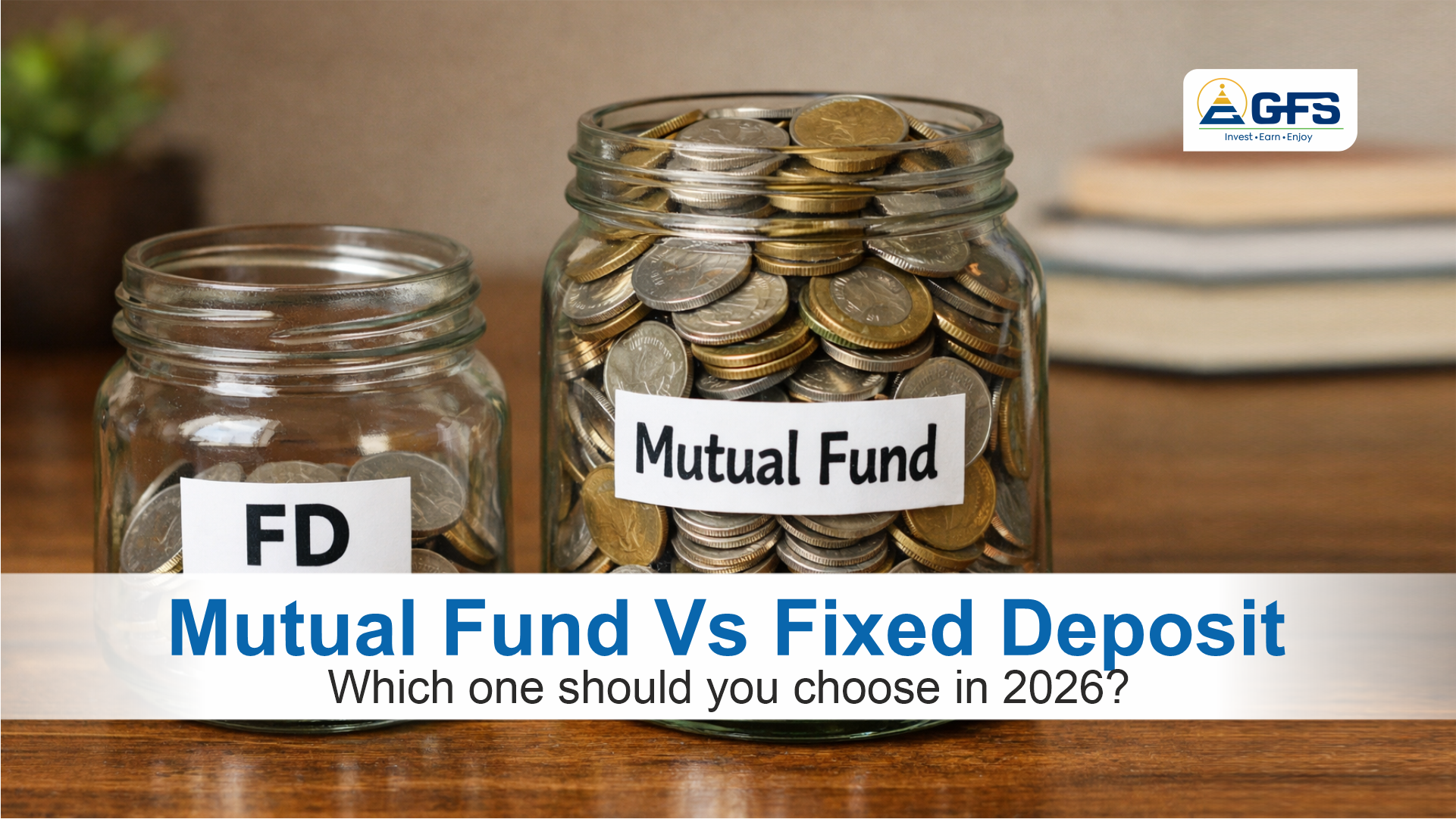
The debate of mutual fund vs fixed deposit isn’t about which is better in general.
It’s about which one is better for you.
Let’s talk about it practically — without exaggeration, without bias.
Why Fixed Deposits Feel Comfortable
Fixed deposits are predictable.
You deposit money.
You lock it for a period.
You know exactly how much you’ll receive at maturity.
There are no surprises.
For many people, especially first-time investors, that certainty feels reassuring.
If your priority is stability and you don’t want to think about market ups and downs, FDs can provide peace of mind.
But comfort has a trade-off.
Your growth is limited to the fixed interest rate. And once taxes and inflation are factored in, the real return may not be as attractive as it appears.
Why Mutual Funds Attract Attention
A mutual fund investment works differently.
Instead of earning fixed interest, your money is invested in markets — equities, debt instruments, or a mix of both.
Returns are not guaranteed.
But over longer periods, mutual funds have the potential to outperform traditional fixed deposit returns, especially when invested with discipline.
Mutual funds are not about short-term certainty.
They are about long-term growth.
The Real Difference Is Purpose
Here’s where most people go wrong.
They compare mutual funds and fixed deposits as if one must replace the other.
That’s not how smart investing works.
Fixed deposits serve a purpose:
-
Short-term goals
-
Emergency reserves
-
Capital protection
Mutual funds serve a different purpose:
-
Retirement planning
-
Wealth creation
-
Beating inflation
-
Long-term goals
When people ask which is better in the mutual fund vs fixed deposit debate, the honest answer is — both can be right.
Just not for the same reason.
Think Beyond Returns
Returns are important. But structure matters more.
Ask yourself:
-
How long can I stay invested?
-
How much risk am I comfortable taking?
-
Do I need liquidity soon?
-
Is this money for growth or safety?
If your time horizon is short and risk tolerance is low, fixed deposits may suit you.
If your goal is long-term wealth building, a disciplined mutual fund investment could be more aligned.
What About Safety?
Many people ask, “Are mutual funds safe?”
Mutual funds are regulated and structured. But they are market-linked.
This means values fluctuate.
That doesn’t mean they are unsafe. It means they require patience.
Fixed deposits, on the other hand, offer predictable returns — but predictable does not always mean powerful.
Especially when inflation quietly reduces purchasing power over time.
Where Guidance Makes a Difference
The confusion usually doesn’t come from the products.
It comes from mismatched expectations.
This is where speaking to a mutual fund distributor or financial advisor can help.
Not to push products.
But to understand:
-
Your financial goals
-
Your income stability
-
Your risk appetite
-
Your time horizon
At GFS, we don’t recommend investments in isolation.
We build structure first.
Then we decide whether fixed deposits, mutual funds, or a combination of both make sense.
Because the right allocation depends on context — not comparison charts.
The GFS Approach
At GFS, our focus is on disciplined financial planning, not short-term excitement.
Sometimes that means allocating funds into fixed deposits for stability.
Sometimes that means building long-term growth through mutual funds.
And often, it means combining both intelligently.
If you are looking for clarity instead of confusion, speaking with a mutual fund distributor who understands portfolio alignment can make a meaningful difference.
Investing should reduce stress — not create it.